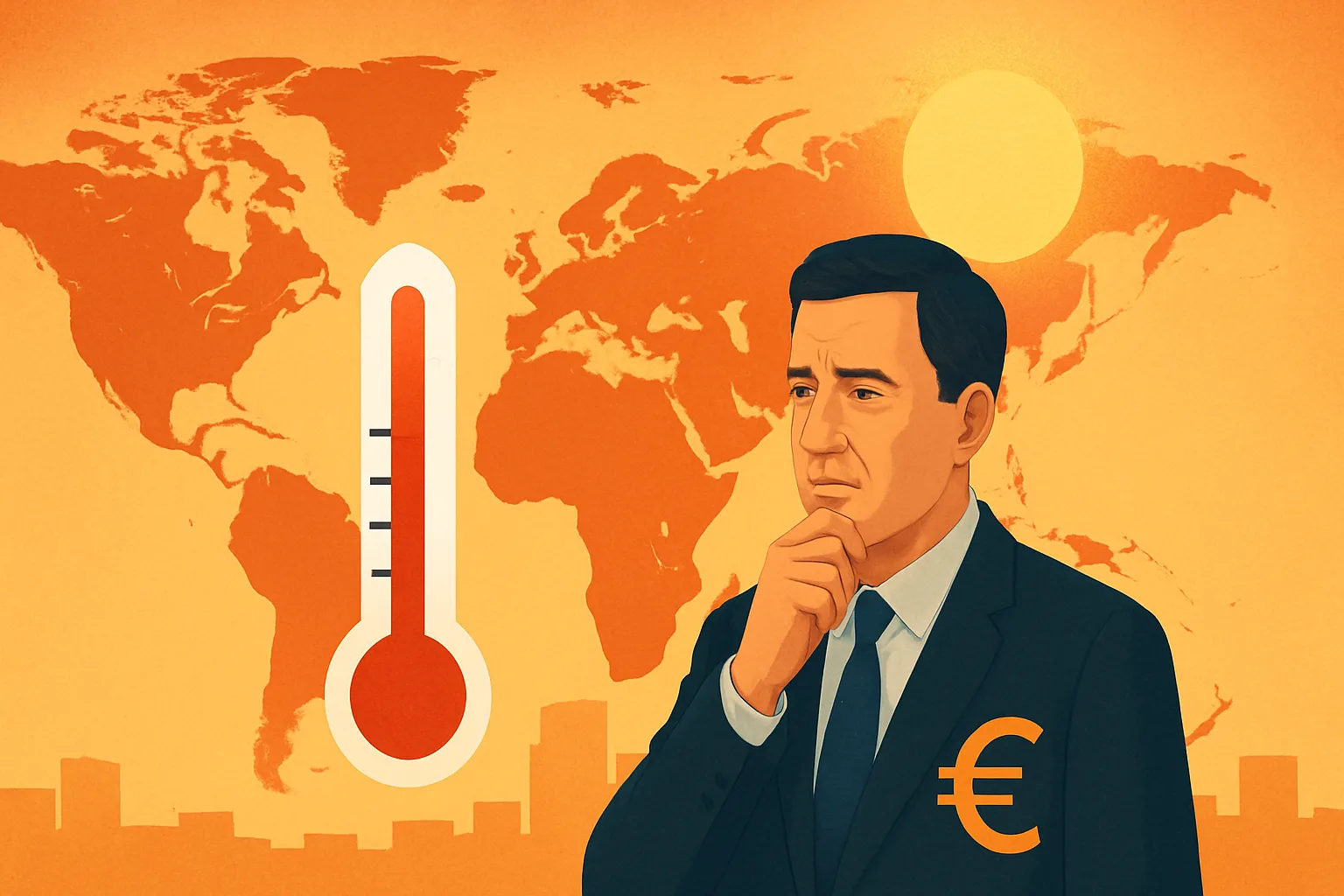
Global climate crisis: hottest August on record amid warnings of an ‘economic security emergency’
The world experienced the hottest August on record, according to datasets compiled by major climate agencies — a development that the UN climate chief says has helped create a "continent-wide economic security emergency" in Europe. The primary focus keyword for this report is "hottest August on record."
What the data show
- Multiple monitoring services, including the European Union’s Copernicus Climate Service, the U.S. National Oceanic and Atmospheric Administration (NOAA) and NASA, recorded unprecedented heat in August
- Key findings reported by the World Meteorological Organization (WMO) and UN agencies include:
- Global sea-surface temperature reached an all-time observed high.
- Global average surface air temperature for August was 1.65°C higher than the estimated pre-industrial baseline.
- The global surface temperature was 1.32°C above the 20th-century average — the warmest August since records began in 1850.
- All 10 of the warmest Augusts on record have occurred since 2016.
These measurements come from consolidated monthly reports; the consistency across independent monitoring systems increases confidence that August 2026 was anomalously warm on a global scale.
Drivers: El Niño and ocean heat
- Scientists and meteorological services point to a strengthening El Niño as a major driver. WMO and related briefings indicate the El Niño event is now firmly established and expected to intensify into a very strong event in the coming months, with impacts persisting into
- El Niño typically raises tropical Pacific temperatures and alters global atmospheric circulation, affecting rainfall, drought and hurricane patterns.
Higher ocean temperatures also played a central role. Record or near-record sea-surface temperatures amplify heatwaves on land, increase evaporation (raising the risk of heavy rainfall and floods in some regions) and can intensify tropical cyclone activity. In August 2026 the global tropical cyclone season produced above-average activity, with 19 tropical storms reported.
Observed impacts around the world
The heat and associated patterns have produced visible impacts:
- The northern hemisphere recorded its warmest summer on record, while the southern hemisphere experienced a near-record warm winter.
- Both the Arctic and Antarctic had below-average sea-ice coverage in August — a signal consistent with elevated polar warming and with implications for ecosystems and shipping routes.
- Europe endured prolonged regional heatwaves and worsening drought conditions, with low water flows reported on major rivers including the Rhine and Danube.
The Copernicus Atmosphere Monitoring Service (CAMS) also linked El Niño conditions to a heightened wildfire risk in regions such as Indonesia during seasonal dry spells.
Economic toll and the UN warning
Simon Stiell, Executive Secretary of the UN Framework Convention on Climate Change (UNFCCC), addressed the European Parliament on the broader socioeconomic impacts of this extreme-weather season. He described the situation as a "continent-wide economic security emergency," citing:
- Tens of thousands of heat-related deaths across Europe this summer.
- Widespread damage to infrastructure, business interruptions and agricultural losses.
- Disruptions to energy supply chains, including forced shutdowns at power stations and water shortages contributing to energy and industrial outages.
Stiell referenced a study estimating the summer's direct economic toll on Europe at about 180 billion euros, equivalent to roughly a full percentage point of EU GDP — effectively erasing the EU's forecast growth for the year.
He stressed that these impacts are linked to continued dependence on fossil fuels and warned of an additional winter fuel crisis unless the energy transition accelerates. Stiell argued that being "soft on climate action is to be soft on inflation and the cost of living, soft on sovereignty and security, and soft on economic growth and jobs."
Mitigation, adaptation and political context
Stiell framed clean-energy deployment as both an economic and security strategy. He noted that renewables now supply about half of Europe’s power mix and that solar generation alone avoided more than 30 billion euros in gas imports during the first six months of the Middle East conflict. Globally, clean energy investment surpassed two trillion dollars last year, roughly double spending on fossil fuels.
Yet Stiell warned that without international cooperation the world could still be headed toward much higher warming. He summarized modeled policy pathways: current policies point to a rise of about 2.6°C this century, while a failure of cooperation would risk warming well above 4°C. He urged the European Union to prioritize implementation at the upcoming COP31 climate conference in Türkiye, focusing on methane reduction, food security and urban resilience.
What comes next
Meteorological agencies expect El Niño’s influence to continue into late 2026 and into 2027, which increases the likelihood of further warm anomalies and extreme events in many regions. The WMO indicated it will present additional climate updates at COP31 in November.
The convergence of record ocean heat, strong El Niño conditions and persistent human-driven greenhouse gas concentrations means near-term climate volatility is likely. That volatility is already producing measurable economic and social impacts. The UN’s call — to treat climate risk as an economic-security issue — frames the next policy choices as decisions that will shape near-term economic stability as much as long-term climate trajectories.
Sources / References
- UN News — "The world just had the hottest August ever" — https://news.un.org/en/story/2026/09/1168317
- UN News — "UN climate chief warns political division is undermining fight against ‘economic security emergency’" — https://news.un.org/en/story/2026/09/1168311