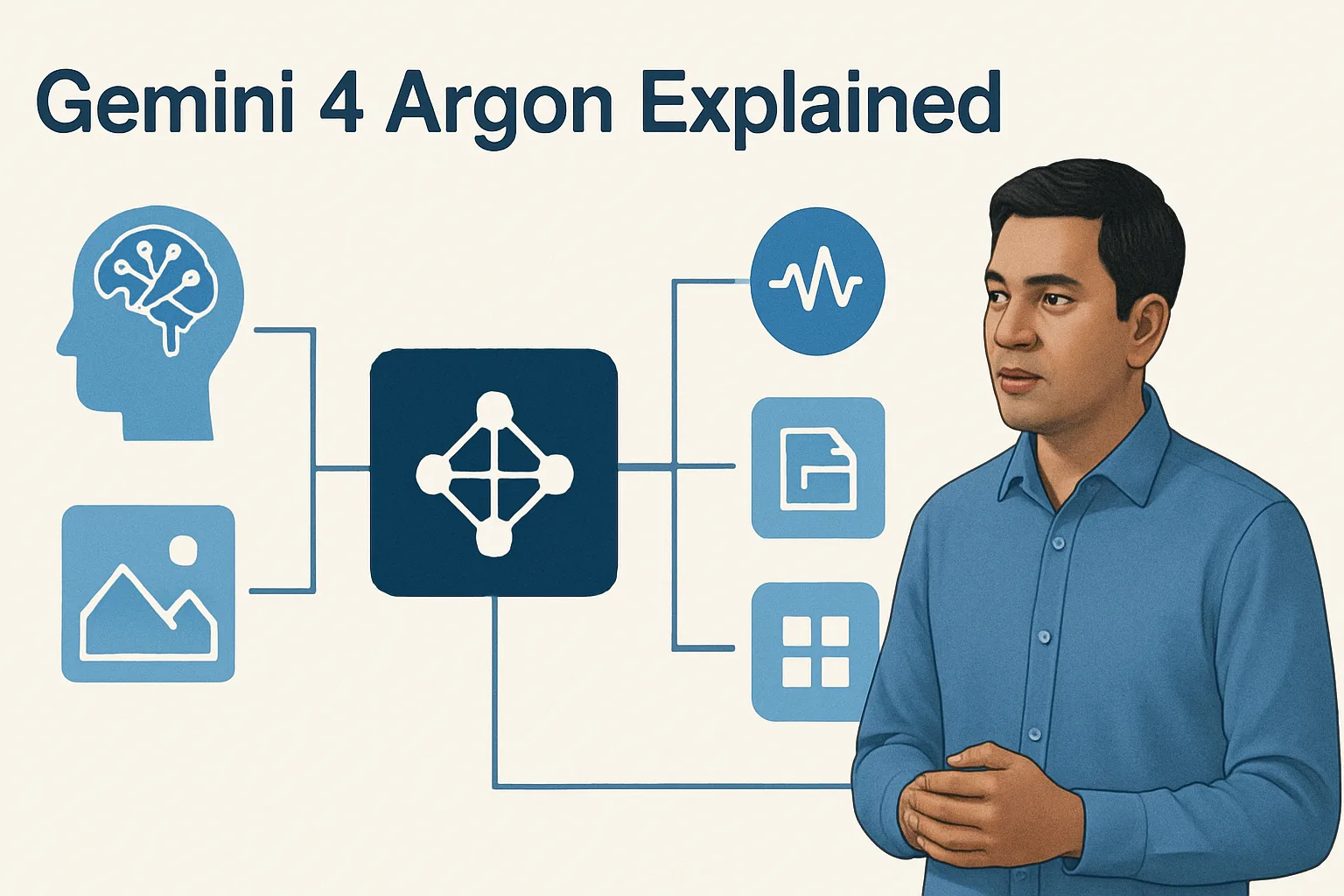
Gemini 4 Argon Explained: What Google's AI Model Architecture Represents
Artificial intelligence technology continues to advance at an unprecedented pace, with major technology companies regularly pushing the boundaries of machine intelligence. Among the leading names in this space is Google, whose Gemini series of models represents a cornerstone of modern foundational AI research. Within this evolving ecosystem, discussions around Gemini 4 Argon focus on the potential architectural leaps in multimodal processing, reasoning power, and compute efficiency.
This explainer breaks down what Gemini 4 Argon represents within the broader AI landscape, how Google's naming and model generation conventions function, and what capabilities tech developers and enterprise users can expect from next-generation AI foundation models.
The Evolution of Google's Gemini Architecture
To understand Gemini 4 Argon, it is helpful to look at how Google has developed its multimodal intelligence systems over recent years. Beginning with initial foundation models like PaLM and migrating to the unified Gemini framework, Google prioritized native multimodality from the outset.
Unlike traditional large language models (LLMs) that were originally text-only and later adapted to handle images or audio via external adapters, the Gemini architecture was designed to handle video, audio, text, code, and images natively within a single transformer network. Subsequent iterations refined long-context processing, allowing models to parse millions of tokens of data simultaneously.
What Does Argon Signify in AI Model Terminology?
In technology naming conventions, codenames such as Argon often denote specific architectural sub-variants, experimental branches, or targeted release tiers. In chemical elements, Argon is a noble gas known for stability and efficiency—traits that align with recent industry demands for lightweight, low-latency AI inference.
- Enhanced Computational Efficiency: Lowering energy consumption and compute latency for high-frequency queries.
- Targeted Reasoning Modules: Improving step-by-step logic and mathematical verification.
- Dynamic Context Retrieval: Enabling intelligent focus over massive datasets without performance degrades.
By building on foundational releases, model variants like Argon serve as crucial stepping stones towards fully autonomous agentic workflows.
Key Technical Capabilities to Expect
Next-generation models in the Gemini lineup aim to solve key challenges faced by previous generations, including hallucination reduction, complex tool use, and real-time audio-visual interaction.
### Native Multimodal Processing Native multimodality means that the model does not convert images or audio into text transcriptions before processing them. Instead, it processes visual frames and audio wavelengths alongside text tokens. This leads to higher nuance in emotional tone detection in speech and finer spatial comprehension in imagery.
### Advanced Logical Reasoning and Coding Reasoning capabilities remain a central metric for foundation models. With advanced code execution environments and integrated search access, models can formulate hypotheses, write code to test those hypotheses, and deliver verified solutions to users.
### Long Context Window and Memory Retrieval Maintaining coherent memory across hours of continuous interaction or thousands of lines of documentation is essential for enterprise adoption. Advanced retrieval techniques help the model retain context without losing fine detail in the middle of long inputs.
Practical Applications for Developers and Businesses
For enterprise applications, the arrival of advanced model tiers enables scalable AI deployment across various sectors:
- Software Engineering: Automated code refactoring, complex bug detection, and continuous integration pipelines.
- Healthcare and Research: Rapid analysis of complex research papers, biochemical data, and patient history summaries.
- Creative and Media Tools: Real-time interactive video editing, context-aware audio generation, and multimodal content creation.
- Customer Support Agents: Intelligent conversational bots capable of executing multi-step business transactions securely.
Industry Context and Competitive Landscape
Google operates in a highly competitive artificial intelligence market alongside competitors like OpenAI, Anthropic, and open-source models from Meta. As frontier models reach high levels of linguistic fluency, the primary differentiators have shifted toward inference cost, latency, reliability, and real-world utility.
Model architectures such as Gemini 4 Argon demonstrate the ongoing shift from static text generation to dynamic problem-solving engines capable of acting as reliable digital assistants and analytical tools.