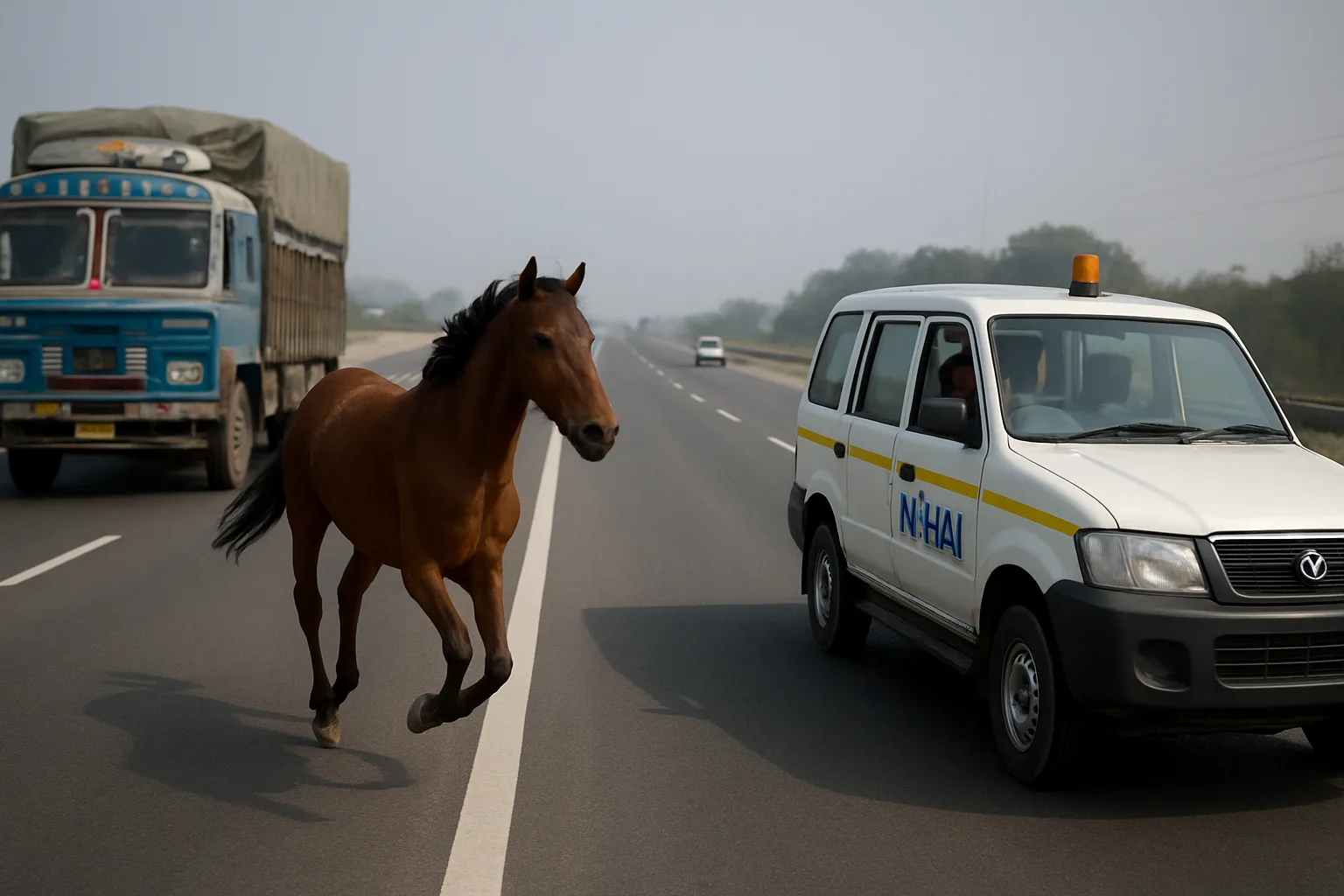
Viral Incident: Stray Horse Gallops Down Lucknow Kanpur Expressway
Drivers traveling along the busy corridor were treated to a surprising sight when a stray horse entered the main carriageway. The animal was captured on video sprinting steadily along the asphalt alongside motorized traffic. The incident, recorded by passing commuters, quickly caught public attention across social media platforms.
Navigating high-speed traffic poses severe hazards for both motorists and stray animals. Vehicles travelling at speeds up to 100 km/h require substantial stopping distances. The sudden appearance of a large animal on such a corridor creates an immediate collision risk, demanding prompt administrative intervention to maintain road order.
Swift Action by NHAI Patrol Teams: A Kilometers-Long Pursuit
Upon spotting the animal, the highway patrol unit assigned to the corridor initiated an immediate response protocol. Rather than attempting a abrupt capture that might startle the animal into traffic lanes, patrol personnel tailed the horse closely from behind.
The escort lasted over several kilometers as the team maintained a protective buffer between the sprinting animal and oncoming vehicular traffic. Utilizing emergency lights and vehicle positioning, officers warned approaching drivers to decelerate, successfully guiding the horse toward an exit ramp without incident.
Eyewitness Accounts and Social Media Reaction
The footage quickly gathered thousands of views across video sharing platforms. Netizens commended the highway patrol officers for their patience and care, noting that a panic-driven response could have resulted in a multi-vehicle pileup or severe injury to the animal.
Commuters present during the event reported that traffic slowed down considerably as the patrol vehicle effectively controlled the lane behind the horse. Observers highlighted the professionalism of the response team, who ensured that normal traffic flow resumed as soon as the animal was guided to safety off the highway access road.
Expressway Safety Challenges: Addressing Stray Animals on High-Speed Corridors
Stray animal intrusions remain a critical concern for highway operators across major transport corridors. The presence of cattle, dogs, and horses on access-controlled routes typically occurs due to breached perimeter fencing, open construction access points, or nearby rural settlements.
Highways designed for rapid intercity mobility require continuous physical barriers to ensure high-speed lanes remain clear. When animals gain access to these arterial roads, the risk of high-impact collisions increases, making continuous fencing inspections essential for operator safety management.
Standard Operating Procedures for Highway Animal Intrusions
The National Highways Authority of India (NHAI) maintains designated standard operating protocols to manage animal sightings on expressways. Patrol vehicles equipped with emergency light bars, public address systems, and traffic cones regularly monitor assigned sectors.
When a large animal is detected, patrol units deploy warning signals to slow incoming traffic while maintaining a safe distance behind the animal. Emergency control centers dispatch specialized animal handling teams or local municipality staff to secure the animal once it has been isolated from active traffic zones.
Infrastructure Measures to Prevent Animal Trespassing on Expressways
Preventing animal entries requires robust physical infrastructure combined with technological surveillance. Expressway developers increasingly utilize crash barriers, heavy-duty wire mesh fencing, and reinforced concrete walls along rural stretches to restrict animal movement.
Modern expressways also feature dedicated underpasses and overpasses designed specifically for local livestock and wildlife movements. Regular maintenance sweeps are conducted to identify and repair damaged fence panels promptly, ensuring perimeter integrity across long highway corridors.
Guidelines for Drivers: What to Do When Encountering Livestock on Highways
- Maintain a safe distance: Avoid sudden braking or swerving, which can cause rear-end collisions with following traffic.
- Turn on hazard lights: Signal immediately to alert vehicles behind you of potential hazards ahead.
- Avoid honking excessively: Loud horn blasts may startle animals and cause unpredictable directional changes.
- Alert toll authorities: Inform the nearest toll plaza or highway helpline (1033) about the precise location of the animal.